So I'm in my hometown of Wichita, KS this week and went to the mall with my sister in law, neice and daughter. On our way out, we were trying to figure out where a certain restaurant is, and I decided to ask a couple mall employees who were on their way out of the building. The woman was White and the man was Black.
The woman said the restaurant was at Harry and Woodlawn and then the Black guy says, "But you probably don't want to go there, there's lots of Black people there."
I laughed and said, "I don't mind Black people - we ARE* Black people." He looked at me like I was crazy and I pointed to my daughter, who is biracial - Black and White. She is fair skinned with freckles, green eyes and red hair - red hair with a kinky, coiled, Black texture. At first glance, many people assume she's just White.
*Let me note that I do not mean to say I think I'm a Black person just because my daughter is, I was saying, "You insult one of us, you insult all of us".
The guy realizes that my daughter is biracial and starts backtracking, but he really just made it worse. "Oh, I was just saying that there are a lot of ghetto people, gang bangers over there."
So . . . he was trying to communicate ghetto and gangbanger by saying Black to me. Awesome. Then he starts touching his hair (which is long, curly & pulled back in a ponytail) and saying how he's "Pretty Ricky". Pretty Ricky is a term used for Puerto Ricans or Black people who look Latino (whether they are or aren't). I take this to mean that he's referring to our whole conversation - Race Can Be Tricky, Y'all - but who knows, maybe I read him wrong. I thanked them for the information and said, "Let's go." Then I ranted in the car for 20 minutes about the way people deal with race in my hometown and scared my sister in law because I was driving fast. Sorry, SIL!
Now - besides recounting this experience, I want to ask a question. I was telling this story on Twitter, and a friend asked me why I use a single racial identifier (Black) for my biracial daughter (specifically I said she is Black-who-looks-White), and whether I ever use "White." I thought about it, and no, I never refer to her or my other two kids as just White, though I occasionally refer to them as Black. More often we use "biracial", "mixed" (outdated & offensive to some, I believe) or "Black and White".
My response is that I let the kids pick their own identifiers and we've talked a lot about them so they know they can pick what they want, when they want. It's their right to decide who they are & how they present themselves. I know my daughter, especially, gets asked the race question (What are you?) often because she has White coloring, a mixture of features, and Black hair texture. She often has to defend that yes, she is in fact Black, because people (usually kids) don't believe her. She mostly says she is bi-racial, Black and White.
I tend to refer to my kids as Black when we're in a situation like the one above - where someone is not taking into account that they have someone non-White in their presence and are saying some foolish stuff. Now, I speak up whether they're with me or not, but making their presence known usually stops the speaking person in their tracks when they realize they're talking about someone actually in front of them.
I also told my friend that after thinking about it, if my kids call themselves Black, I don't feel as though they are denying their White side. But if they were to call themselves White, I would feel as though they are denying their Black side.
My friend is concerned that my perspective on this is adding to the "one drop" concept - that a single drop of Black blood negates a person's Whiteness. This is a concept that has been used to discriminate against people of mixed ancestry.
You all know that I care a lot about race, that I talk about it, learn about it, try very hard to grow and get rid of prejudices I've grown up with. What do you think about this, and how I've been viewing race in terms of how my kids identify, and how I identify them?
For myself, I think that my friend is right - I am bolstering that concept . . . but knowing that doesn't change how I perceive my kids' race. I'm not saying I won't work on changing this perception - I probably will. I'd like to know your thoughts, though.
Showing posts with label race. Show all posts
Showing posts with label race. Show all posts
Sunday, July 29, 2012

Thursday, January 5, 2012
Rut Roh, White Girls!!
Have you seen @Chescaleigh's video, "Shit White Girls Say . . . to Black Girls"? It's hilarious and true and good for conversations!
So what do you think - have you said or done any of this stuff?
I certainly have, most recently using the word HOLLA!!! a lot. Like, A LOT. Of course, I actually say "holla" and not "holler". ;)
You can see more funny videos by Franchesca here, or check her out elsewhere:
Tuesday, May 17, 2011
Hard Truths Aren’t True, Just Hard To Read Without Putting My Fist Through A Wall

Kanazawa’s article was titled, “Why Are Black Women Less Physically Attractive Than Other Women?”
Someone on Twitter brought my attention to the article and I read it, getting more upset the more I read. The article is no longer accessible on the PT website but you can read it in its entirety here.
The article basics: Research indicates that we think Black men are more attractive than other men, but we think Black women are less attractive than other women.
I now have a copy of the article from someone who had the foresight to copy/paste it into a Word doc, but I did get to read it all the way through before it was taken off the site. The only reference to the research done to stake these claims is the mention of the “Add Health” survey taken by respondents (men and women) in three stages. It says that respondents were surveyed three times, with the same questions each time. There is no link to what Add Health is and there is no other information provided in the article about who administered the survey, who these men & women are, how many there were, what races, ethnicities, ages, etc. they were, or what questions were asked.
I Googled, “Psychology Today Add Health” and then “Add Health” and found a few different results that pointed to “Add Health” being a shortened name for a major study. The National Longitudinal Study of Adolescent Health interviewed over 20,000 teens and over 17,000 of their parents about many things, however, the survey is considered to be in general, about sexuality. Beginning in the mid 1990s, teens in the United States were surveyed, then a few years later were surveyed again (though surveyors weren’t able to find the entire original sample group), then a few years later surveyed again. The study reports its findings from the entire six year period.
Having read this far, you might think, ok . . . so what? A poorly referenced article tells us that according to a major U.S. study, teens and their parents think Black women aren’t as attractive as other women. That really sucks.
And?
Here’s the “and”: MY BAD, the language of the article doesn’t actually say that people think Black women are less attractive. It flat out says, Black women ARE less attractive. For example, it says,
“It is very interesting to note that, even though black women are objectively less physically attractive than other women, black women (and men) subjectively consider themselves to be far more physically attractive than others.”
It also states that there are differences in intelligence, based on race:
“Nor can the race difference in intelligence (and the positive association between intelligence and physical attractiveness) account for the race difference in physical attractiveness among women.”
Bell Curve, anyone?
It gets worse. This article states opinion as though it were fact and it misuses and mis-states the results of research undergone for other purposes . . . but it also is operating under the premise that the European standard of beauty is the standard that all should be judged by. That photo up at the top? That’s the image that PT ran with this article. The findings that Americans think Black women are the least attractive of all the races? Sad and disgusting, but indicative of our accepted and perpetuated standard of beauty. Guess which race has features that consistently do NOT fit inside the measurements of that photo? And guess which race does?
Though the accepted cultural belief that Black women aren’t beautiful – are actually LEAST beautiful - is very sad, it’s not shocking to me. What IS shocking (Wait, why? Why is it shocking?) is that an enormous publication like Psychology Today would publish this crap. You know, it would have been one thing if they’d published the findings and said, “Man, we have work to do! We all know beauty is subjective and these results point to some serious problems in our society’s perception of beauty. What can we as psychologists and mental health professionals do to combat this?” But no – they published an article that had ZERO links to references, stating that Black women ARE less attractive than other women. Period.
Did you know that people of color (POC) are largely under-represented in the field of psychology? I work with psychologists and people studying to become psychologists – I see the anecdotal evidence to this five days a week. Guess where else POC are under-represented? In receiving care for their mental health. And of those who do receive care? They are usually treated by someone who is White.
That editors at Psychology Today saw this article as fit to publish boggles my mind. We have GOT to do better.
Here are some more great takes on this article:
Kristen Howerton from Rage Against the Minivan (includes 2 great videos and a comment from me! ha)
Racialicious (includes awesome graph and snippets of blogs from all over)
Confessions of a Cybernegress (last sentence packs a punch. So true!)
Kristen Howerton again – thoughts on the way Twitter was used to call out Psychology Today
And here is a letter from another author published on Psychology Today . . . Hmm . . . should they be off the hook?
Wednesday, February 23, 2011
Chicago Politics: Post-Racial?
Yesterday was election day in Chicago (surely in other places as well) and a couple of the election results were historic. The biggest newsmaker was the election of Rahm Emanuel as our new Mayor. Chicago is the 3rd largest city in the U.S., so the person in the Mayor’s seat has a great deal of responsibility and power. Chicago is known for its corrupt politics . . . I’ve said that in a system so corrupt, you can’t survive and operate without being a part of or at the very least allowing corruption. We’ll see if any of that changes under Rahm (which is what people call him, by the way – not Emanuel – even his campaign signs say RAHM in large letters, where most campaigns emphasize the candidate’s last name).

Rahm Emanuel and his RAHM FOR MAYOR sign.
Rahm’s election was historic in a couple of ways. First, he’s not a Daley!

Richard J. Daley
Richard J. Daley was the Mayor of Chicago from 1955 until 1976, when he died. His story is very interesting, you can read the highlights here. He was the Mayor who held the second-longest term in Chicago – his son, Richard M. Daley beat him – he was Mayor from 1989 until . . . well, he’s still our Mayor. Rahm will take over for him in May. Learn more about him here.

Richard M. Daley
Second, Rahm is Jewish – he will be Chicago’s first Jewish Mayor. He’s also spent time as Obama’s Chief of Staff, as an advisor to Clinton, and as a congressman. His entire family is interesting, but you might enjoy the fact that Jeremy Piven’s character in Entourage is based on Rahm’s brother Ari, who is an agent in Hollywood.
Another historic election result was Chicago’s first Indian-American alderman (alderman are kind of like neighborhood Mayors), Ameya Pawar, who works at Northwestern University.

Ameya Pawar
He notably ran as an Independent and is only going to accept a $60K salary rather than the standard $110K salary offered to aldermen, and will only serve 2 terms. You can read more about his plans as alderman here.
This article details why Pawar’s win was surprising, and gives you an idea of the cronyism that persists in Chicago politics. I’m having issues with the quote at the end of the article – no one from the neighborhood is from Chicago? Said by a woman from “good Chicago Polish stock”? (FYI, Chicago has the 2nd largest concentration of Polish people in the world – Warsaw has the 1st). I’m definitely one to understand frustration at gentrification, but I hate the implication that is given by tying this quote to a story about the first Indian-American alderman. He’s from the Chicago area yet the implication is that he’s not really from Chicago. Because he’s suburban? Or because he’s Indian?
The reason I began writing this entry is because last night, a newsanchor covering these stories noted that because people of all races voted for Rahm, and because an Indian-American defeated an Irish candidate in a traditionally old-Chicago ward, we are now living in a “post-racial Chicago” . . . Obama’s election was also referenced.
I’m sorry, but we are hardly post-racial. Chicago is an incredibly diverse city – ethnically, racially, socioeconomically. I’m sure we have someone from every corner of the world here. Yes - wards that have traditionally voted for one race or ethnicity voted for non-traditional candidates yesterday – and that’s awesome. But Chicago is also an extremely segregated city, and poverty is greatest in Chicago’s “brownest” neighborhoods. I don’t think we’ll ever live in a post-racial world, country or city, but saying things like this just gives everyone an excuse to stop working toward improvement.
Wednesday, February 16, 2011
Black History Month: What's the Point?

My computer ate my original post, so with this re-write I'm going to be really brief:
What, in your opinion, is the purpose of Black History Month? Why is it around? Do you think it has been effective in its mission?
I plan to re-visit this topic a few times and it will probably lead to other related topics.
**note - I do have opinions on this topic . . . just hoping to get a little feedback first before I share my point of view. If you're looking for an idea of my perspective, click on the "race" and "racism" tags at the bottom of this entry**
Disclaimer - I know race can be a scary topic to discuss, so let me be clear - this is a safe zone to talk! I honestly don't think anything inflammatory is going to go on in the comments to this blog, but if you're hesitant to say anything because you think I or someone else will flame you - know that I don't get down with that stuff. I like to talk about these difficult topics but I don't think being mean is productive. Even when disagreeing, I try to do so respectfully.
Monday, October 11, 2010
Reconsider Columbus Day!
Do you celebrate Columbus Day? Do you talk to your kids about it? Do you not really think about it?
I understand why we celebrate it - it's good to think about where "we" started. But is that really where "we" started? And is it ok to act like what Columbus (and his peeps) did was honorable, since it got us to where we are today?
I don't think we should celebrate Columbus Day. I think we should replace it with a Native American remembrance day. Not just to celebrate their culture - that's important and I'm glad we have a Native American Heritage Month (November) but Iwould like a day that focuses on honoring the great loss that the native nations suffered.
I hate our reluctance to admit that we screwed up. Today, one of my co-workers posted a motivational quote on Facebook, and it started out something like, "Remember, there are no mistakes - only lessons learned."
Ok - I get that sometimes we beat ourselves up too much and get stuck focusing on the negative. But why can't we call a mistake, a mistake? We did likely learn a lesson from it - but it was still a mistake. Why live under a mantra of "I don't have regrets"? What is so wrong with admitting your imperfection? What is so wrong with saying "I have not always made the best choices?"
This bugs me, both personally and as part of our national culture. Why can't we just say that we got some things horribly wrong? Why can't we be willing to teach our kids that along with the "freedom" we fought for, we also stepped on a lot of people to get to where we are today?
This is the sort of blind nationalism and "patriotism" that I don't understand. I want my children to be able to see the good and the bad and to weigh pros & cons. I don't want my kids to blindly follow ANYTHING.
I think we should get rid of Columbus Day. It's time that we as a nation set this straight.
Visit the Reconsider Columbus Day website- learn about some who are petitioning to change the day. Here is the petition content (coloring mine):
To: All people of the world
Congress of the United States
Senate of the United States
President of the United States
We the undersigned come together before you to request that each of these governing bodies take all necessary action to bring about a Federal Holiday for Native American Elected Leaders, To include Congressional hearings on the racial exclusion of Native Americans in movies, television, sports advertising, music companies, etc.
With the special government to government relationship between the Indian Government of America and the Federal Government it is fitting for the Federal Government to enact this holiday, and conduct Congressional hearings.
Indian governments and the people they represent are requesting that the federal government bring about a National Holiday for Native Americans to be celebrated by all citizens of America and people around the world.
This holiday would pay tribute to Indian Tribal Leaders to include Alaskan Leaders and Hawaiian Leaders. This holiday would also pay tribute to those that endured the world's longest holocaust and most costly in human lives.
It is further stated that no Indian Government nor its people find reason to celebrate and pay for Columbus Day.Seventeen states do not recognize Columbus Day. The state of South Dakota has changed Columbus day to Native American Day.
Therefore be it resolved that the Federal Government should reevaluate Columbus Day by moving it back to its original day the second Wednesday of October and not be a tax paid holiday as is St. Patrick's Day and Octoberfest, and make the second Monday of October a Federal holiday for Native Americans.
The polls we conducted across the country show that the vast majority of Americans prefer changing Columbus Day as to creating a whole new holiday.
It is inappropriate for Indian children and children of America to celebrate Columbus discovering a nation of people and not having a holiday paying tribute to the people of those nations.
I understand why we celebrate it - it's good to think about where "we" started. But is that really where "we" started? And is it ok to act like what Columbus (and his peeps) did was honorable, since it got us to where we are today?
I don't think we should celebrate Columbus Day. I think we should replace it with a Native American remembrance day. Not just to celebrate their culture - that's important and I'm glad we have a Native American Heritage Month (November) but Iwould like a day that focuses on honoring the great loss that the native nations suffered.
I hate our reluctance to admit that we screwed up. Today, one of my co-workers posted a motivational quote on Facebook, and it started out something like, "Remember, there are no mistakes - only lessons learned."
Ok - I get that sometimes we beat ourselves up too much and get stuck focusing on the negative. But why can't we call a mistake, a mistake? We did likely learn a lesson from it - but it was still a mistake. Why live under a mantra of "I don't have regrets"? What is so wrong with admitting your imperfection? What is so wrong with saying "I have not always made the best choices?"
This bugs me, both personally and as part of our national culture. Why can't we just say that we got some things horribly wrong? Why can't we be willing to teach our kids that along with the "freedom" we fought for, we also stepped on a lot of people to get to where we are today?
This is the sort of blind nationalism and "patriotism" that I don't understand. I want my children to be able to see the good and the bad and to weigh pros & cons. I don't want my kids to blindly follow ANYTHING.
I think we should get rid of Columbus Day. It's time that we as a nation set this straight.
Visit the Reconsider Columbus Day website- learn about some who are petitioning to change the day. Here is the petition content (coloring mine):
To: All people of the world
Congress of the United States
Senate of the United States
President of the United States
We the undersigned come together before you to request that each of these governing bodies take all necessary action to bring about a Federal Holiday for Native American Elected Leaders, To include Congressional hearings on the racial exclusion of Native Americans in movies, television, sports advertising, music companies, etc.
With the special government to government relationship between the Indian Government of America and the Federal Government it is fitting for the Federal Government to enact this holiday, and conduct Congressional hearings.
Indian governments and the people they represent are requesting that the federal government bring about a National Holiday for Native Americans to be celebrated by all citizens of America and people around the world.
This holiday would pay tribute to Indian Tribal Leaders to include Alaskan Leaders and Hawaiian Leaders. This holiday would also pay tribute to those that endured the world's longest holocaust and most costly in human lives.
It is further stated that no Indian Government nor its people find reason to celebrate and pay for Columbus Day.Seventeen states do not recognize Columbus Day. The state of South Dakota has changed Columbus day to Native American Day.
Therefore be it resolved that the Federal Government should reevaluate Columbus Day by moving it back to its original day the second Wednesday of October and not be a tax paid holiday as is St. Patrick's Day and Octoberfest, and make the second Monday of October a Federal holiday for Native Americans.
The polls we conducted across the country show that the vast majority of Americans prefer changing Columbus Day as to creating a whole new holiday.
It is inappropriate for Indian children and children of America to celebrate Columbus discovering a nation of people and not having a holiday paying tribute to the people of those nations.
Wednesday, September 1, 2010
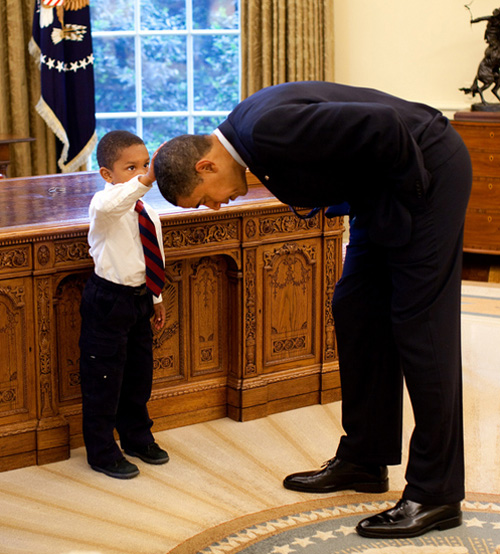
Having a self-identified black man in the White House matters. Yes, it does.
I've had this photo and caption from Love Isn't Enough (formerly Anti Racist Parent) posted outside my office door for over a year. Today a new student stopped by to tell me she appreciated the photo and it was an example of why she chose to attend our school. The fact that I'm not only allowed but encouraged to express this sort of sentiment is why I chose my school as an employer.
In other Obama news, I had a good discussion with friends on Facebook today about whether combat for American soldiers in Iraq is really over or not. Looks like it's not - maybe combat lead by Americans but the truth is that Americans will engage in combat in Iraq indefinitely. Please do not think the war is over. The war simply has a different name in Iraq and a lot of it has moved over to Afghanistan.
Tuesday, June 29, 2010
Welfare
I am inching my way through some books on welfare, welfare reform, welfare racism.
The first one was really moving, the author interviewed 30 women on welfare (from different states, different regions, different size/type of town/city/rural area), who have kids. The book goes topic by topic & you see the women’s situations compared to each others . . . there are so many common themes. Hard-work, determination, hopelessness, abuse, abandonment, lack of education. So, so many cases where the women were abandoned by the fathers. Lots of abuse, and a surprisingly high number of women who were married to the father of their children . . . and the father left the family or was abusive or was an addict. Not as many cases of women who were never married.
There were a couple examples of women who were disabled or who were unable to work because there simply was no work in their area. The majority (and I mean like 90%, not 60%) had worked since they were teenagers in factory jobs, waitressing jobs, caregiver jobs. The problem is that the work available in their area, that they could get to with their transportation, that they were qualified for – was so low in pay and benefits (no flexibility on hours, if your kid is sick you lose your job, no health benefits, no vacation) that in order to survive they had to get on welfare. And still they lived a meager existence.
In the welfare reform book I learned that each state is different, but that the 1996 federal reform act required states to make ALL welfare recipients work. Some states (possibly all of them) have exemptions to hand out to special cases (where someone physically can’t work, for example). Some states use all their exemptions, some states barely use theirs. The percentage of exemptions was very small compared to the percentage of cases who had to work.
What I’m seeing over & over is that the requirements put upon those who get welfare benefits, and the training/education opportunities just don’t do enough to actually lift the families out of poverty. So the families aren’t getting welfare any longer but they’re still living in poverty, and now mom isn’t able to be in the home at all to parent her kids.
Did you know that in the beginning, welfare was given out to women whose husbands had died, because women weren’t yet enough a part of the workforce that without a husband/provider, the family would starve? And that only women who were seen as “good” and “worthy” were given benefits? The women who had children out of wedlock or who left abusive husbands (and surely other situations) weren’t allowed benefits because they weren’t seen as promoting the ideal values for society?
The actual purpose of welfare in the beginning was to allow women to stay home and raise their children because this is how you created a healthy society. But today if you want welfare benefits you have to work or prove that you are actively seeking work, or are in some sort of educational program (and often then you still have to work).
Women who receive child-support payments from their children’s father only get a small portion of the payment (something like $50 a month) if they are on welfare. The state takes everything over $50 to offset the benefits they are giving to the woman/children. So even if a woman gets a total of $500 worth of benefits from the state, if her ex pays $700 in child support, she gets $50 while the state gets $650.
This may vary state-to-state or it may be all states, – did you know that there is a 5 year cap for receiving benefits? And many states don’t allow those to be consecutive years? Some states have a system like this: 2 years on benefits, then you must survive for 2 years off. Then you can have 2 more years, then you have 2 more years off. Then you can finish up with your last year of benefits, and then you are done and can never receive benefits again, no matter what.
Did you know that some states give as little as $64 a month for children born to a mother who is on welfare? There may be other states that give more or less but I don’t have that info. That doesn’t seem like a big incentive to have a child to me. AND those benefits are not necessarily cash!
Did you know that some states give ZERO benefits for a child born to a mother who is on welfare? Again – speaks to the motivation of women having babies so they can live off the state via their children.
When the 1996 welfare reforms went into place, a ton of money was put into the welfare system . . . also a ton of regulations, to the point that resources were spent on creating duplicate forms in multiple formats . . . entering data into multiple databases . . . training & re-training & re-training. Red tape grew & grew & grew. Employees who worked for welfare agencies were given raises while benefits to the individuals on welfare were actually cut.
The number of benefit cases from 1997 – 2001 were cut in half! It is harder to get welfare, it is harder stay on welfare, it is harder to transition from welfare to an above-poverty situation, it is harder to manage welfare.
Yet the myths - that most people on welfare are freeloaders who are lazy, don’t work, are milking the system and live on welfare their entire lives - persist.
The first one was really moving, the author interviewed 30 women on welfare (from different states, different regions, different size/type of town/city/rural area), who have kids. The book goes topic by topic & you see the women’s situations compared to each others . . . there are so many common themes. Hard-work, determination, hopelessness, abuse, abandonment, lack of education. So, so many cases where the women were abandoned by the fathers. Lots of abuse, and a surprisingly high number of women who were married to the father of their children . . . and the father left the family or was abusive or was an addict. Not as many cases of women who were never married.
There were a couple examples of women who were disabled or who were unable to work because there simply was no work in their area. The majority (and I mean like 90%, not 60%) had worked since they were teenagers in factory jobs, waitressing jobs, caregiver jobs. The problem is that the work available in their area, that they could get to with their transportation, that they were qualified for – was so low in pay and benefits (no flexibility on hours, if your kid is sick you lose your job, no health benefits, no vacation) that in order to survive they had to get on welfare. And still they lived a meager existence.
In the welfare reform book I learned that each state is different, but that the 1996 federal reform act required states to make ALL welfare recipients work. Some states (possibly all of them) have exemptions to hand out to special cases (where someone physically can’t work, for example). Some states use all their exemptions, some states barely use theirs. The percentage of exemptions was very small compared to the percentage of cases who had to work.
What I’m seeing over & over is that the requirements put upon those who get welfare benefits, and the training/education opportunities just don’t do enough to actually lift the families out of poverty. So the families aren’t getting welfare any longer but they’re still living in poverty, and now mom isn’t able to be in the home at all to parent her kids.
Did you know that in the beginning, welfare was given out to women whose husbands had died, because women weren’t yet enough a part of the workforce that without a husband/provider, the family would starve? And that only women who were seen as “good” and “worthy” were given benefits? The women who had children out of wedlock or who left abusive husbands (and surely other situations) weren’t allowed benefits because they weren’t seen as promoting the ideal values for society?
The actual purpose of welfare in the beginning was to allow women to stay home and raise their children because this is how you created a healthy society. But today if you want welfare benefits you have to work or prove that you are actively seeking work, or are in some sort of educational program (and often then you still have to work).
Women who receive child-support payments from their children’s father only get a small portion of the payment (something like $50 a month) if they are on welfare. The state takes everything over $50 to offset the benefits they are giving to the woman/children. So even if a woman gets a total of $500 worth of benefits from the state, if her ex pays $700 in child support, she gets $50 while the state gets $650.
This may vary state-to-state or it may be all states, – did you know that there is a 5 year cap for receiving benefits? And many states don’t allow those to be consecutive years? Some states have a system like this: 2 years on benefits, then you must survive for 2 years off. Then you can have 2 more years, then you have 2 more years off. Then you can finish up with your last year of benefits, and then you are done and can never receive benefits again, no matter what.
Did you know that some states give as little as $64 a month for children born to a mother who is on welfare? There may be other states that give more or less but I don’t have that info. That doesn’t seem like a big incentive to have a child to me. AND those benefits are not necessarily cash!
Did you know that some states give ZERO benefits for a child born to a mother who is on welfare? Again – speaks to the motivation of women having babies so they can live off the state via their children.
When the 1996 welfare reforms went into place, a ton of money was put into the welfare system . . . also a ton of regulations, to the point that resources were spent on creating duplicate forms in multiple formats . . . entering data into multiple databases . . . training & re-training & re-training. Red tape grew & grew & grew. Employees who worked for welfare agencies were given raises while benefits to the individuals on welfare were actually cut.
The number of benefit cases from 1997 – 2001 were cut in half! It is harder to get welfare, it is harder stay on welfare, it is harder to transition from welfare to an above-poverty situation, it is harder to manage welfare.
Yet the myths - that most people on welfare are freeloaders who are lazy, don’t work, are milking the system and live on welfare their entire lives - persist.
Saturday, June 26, 2010

PBS Independent Lens documentary: Crips and Bloods: Made In America is about how/why gangs got started in LA, how they’ve evolved and the conditions that keep the South Central LA community stuck in the cycle of gangs, drugs & violence. It also highlights the work that is being done to try to make changes . . . and the work that has to be done from outsiders in order to make change possible.
On the website, there is a map where you can hover over the different things like liquor stores, crime, home ownership & homelessness, gang violence, schools, prison statistics, employment, grocery stores, health clinics, hospitals – the information about the disparities of what is in South Central compared to more affluent areas of LA is disgusting.
The map also highlights some historical events that happened in South Central.
Definitely worth checking out if you get the chance!! You can check out a preview, look on the movie link above & on the top right of the screen. AND you can also find out when it will play next on your local PBS station – my station is going to show it again this Sunday, so it’s likely that yours will be showing it sometime soon as well.
From the director:
I made CRIPS AND BLOODS: Made in America because I was interested as a filmmaker and as a resident of Los Angeles in investigating why gang violence has been going on uninterrupted in Los Angeles for over four decades. I could not understand why this is going on in America and why no viable solution has ever been put into place. And it did not make sense to me, our country defeated Nazi Germany and Japan simultaneously and in less than a decade but we can’t stop gang violence. It made me wonder if as a society we would find a solution to this problem if instead of poor African American teenagers it were affluent white teenagers who were killing each other.
Kumasi, one of the principle characters in the film says this, “Part of the mechanics of oppressing people is to pervert them to the extent that they become their own oppressors.” I believe these young men involved in gang violence are carrying out their own extinction and the very sad truth is that our society is allowing this to happen. I hope people who view the film see these gang members as human beings caught up in a tragic nightmare and not as the animals and demons the media has made them out to be.
I believe people should see this film because this is a human rights issue that is happening inside of America and it’s happening every day in many of our largest cities—but it happens in silence. These young men are dying in silence and they are being incarcerated in silence. More people have been killed due to gang violence in Los Angeles than the long running sectarian conflict in Northern Ireland, yet very few know this fact. Young children in South Los Angeles are experiencing greater levels of Post Traumatic Stress Disorder than children living in Bagdad, Iraq. This is happening inside of our country.
—Stacy Peralta
Meet four of the men featured in CRIPS & BLOODS: Made in America.
Skipp

“I grew up in a home where my mother worked two jobs, but had three boys. …We were unsupervised, so I found my supervision outside of the home.”

“I grew up in a home where my mother worked two jobs, but had three boys. …We were unsupervised, so I found my supervision outside of the home.”
Skipp was born Clifford Townsend in Los Angeles. Forty-four years old at the time of filming, he became a member of the Rollin’ 20s Bloods at the age of 13. Although he became inactive in 1998, he feels as though he has never really left his gang. He has spent almost seven years of his life in the U.S. prison system and is currently working towards his bachelor's degree in child development. Skipp recently created his own organization specializing in community intervention, re-entry, mentoring and gang intervention. He also assists with training Los Angeles Police Department officers on community relations and works within the city’s school system to make an impact on at-risk youths.
Kumasi

“…But the point is this: I'm a walkin' time bomb. I'm gonna go off. Some day, somewhere, on somebody. The question is: 'Upon whom?'"
Kumasi was born in Bronx, New York and moved to South Los Angeles at age three. Sixty-one years old at the time of filming, he joined the Slausons at age 10. He still considers himself a Slauson, although the gang became inactive around 1967. Kumasi has served a total of five terms, or about 18 years, in the U.S. prison system during his life. He currently works as a consultant and activist within his community and as a consultant in the entertainment industry.
Shaka

“So, a lotta times, man, I know morally I'm a good individual, but sometimes I gotta put that moral state of mind behind me and become an animal.”

“So, a lotta times, man, I know morally I'm a good individual, but sometimes I gotta put that moral state of mind behind me and become an animal.”
Born in Los Angeles as Rodney Moralez, Shaka joined Mad Swan Bloods (currently known as Family Swan Bloods) at the age of 13. Twenty-eight years old at the time of filming, he still considers himself a Swan, although he became less involved with the gang after becoming a father, and has become inactive in recent years. Shaka has spent three terms, totaling six years, in the U.S. prison system. He is currently working as a hip hop and reggae artist in the music industry and is starting up a church and basketball program for at-risk youth.
Scrap

“I grew up in a house where my grandma and my uncle, everybody was sellin' drugs. You, know what I'm sayin'? I grew up to where when the police raid, they handed me drugs to hide…”

“I grew up in a house where my grandma and my uncle, everybody was sellin' drugs. You, know what I'm sayin'? I grew up to where when the police raid, they handed me drugs to hide…”
Born Raymond Ford in Los Angeles, Scrap was thirty-two years old at the time of filming. Growing up in Jordan Downs Housing Project in Watts, he feels that he was born into a gang. Scrap became an active member of the Grape Street Watts Crips at 11 years old and became inactive in 2003, after his best friend was murdered. As a juvenile, he spent one year in a youth authority camp. He currently works full time as a football coach, and part time doing gardening work for the city.
Tuesday, March 2, 2010
Ignoring a problem won't make it go away - Take 2


Yesterday, after reading My Sister's Farmhouse's new post on how Christian Private schools are just a euphmism for White Flight, I got all hot under the collar and posted about how Pioneer Woman's plans for teaching diversity to her chidlren were just wrong. They were wrongity wrong. Oh, and also? THEY WERE WRONG!!!!!
The comments at MSF devolved, oh, how they devolved. And some real racists came out. Of course, most people today don't look at them as racists, after all, where were their burning crosses? For example, just because they referred to non-Whites as people who have a new baby's daddy every month, that's not RACIST . . . they're just talking about their experience. Right? Anyway, reading those comments made my head explode so I had to stop.
Today I deleted my blog because it was just a rant and what good was it doing? Going back to MSF to check on the new comments ('glutton' might be my middle name) I see someone's link to their own reaction to Pioneer Woman's diversity blog, back when it was originally posted. And what she had to say, and what her commenters had to say, was everything I wanted to say yesterday, but couldn't, because my fingers wouldn't type properly (due to the rage).
So, here. Read what Megan and her friends have to say. It's what I wish I'd said.
Thursday, May 21, 2009
Yes, it does!
this is what i love about obama being in office. most people i've said that to think i'm very wrong to feel this way.from anti-racist parent:

Having a self-identified black man in the White House matters. Yes, it does.
This photo from the White House Flickr account shows a young boy rubbing President Barack Obama’s head. Reportedly, “The youngster wanted to see if the President’s haircut felt like his own.”
Having a self-identified black man in the White House matters. Yes, it does.
Saturday, November 8, 2008
Race and Comfort
this entry is really a comment i left on someone else's blog . . . they were writing about class distinctions and the often un-noticed privileges that come with being upper-class in the US.
have you seen the show 30 days? it's the show by morgan spurlock, the guy who did the movie SUPER SIZE ME. every episode takes a person who feels strongly about some issue and plunks them down to live in the opposite side of the issue, for a month.
the most moving one i've seen is where they had a guy who is hardcore about illegal immigrants. he works for the border patrol -- i think maybe as a volunteer? (or all they all volunteers?). so he was sent to live with an illegal family in LA for a month. i know he was very changed at the end although i can't remember whether or not he changed his viewpoint. i know for sure that he went away w/more compassion.
anyway -- i thought of that when you said why would people want to keep coming here if their lot here would be to beg in a mall? that made me think of that episode -- because that family, they didn't beg, but part of the show was the border patrol guy going to mexico to where the family had come from. they couldn't go or they wouldn't get back in the US. what he saw was so unimaginable to him, the conditions the family had lived in before.
so, i guess -- when coming from a situation like that, a person is willing to throw their pride under the bus if it means their kids won't have to live *literally* with no roof over their head.
you are so right about the class stuff as well. i have thought a lot about that in terms of race, having been in so many situations in my life where i'm the only (or one of the only) white people around. and of course when i married vincent that grew & then when we moved to chicago that just got magnified. at family functions, church, the kid's school (before we moved to the suburbs), the store, the train, the bus -- literally every aspect of my life that was not WORK -- i was the only white person. because you can exist on the south side without running into white people unless they are cops or teachers or social workers or something. they simply do not live there except in certain areas that are closer to downtown.
i think both because of just who i am (my default setting) and my life experiences, i have pretty much grown into feeling totally comfortable even if there are no other whites around. it got to the point where if someone would point out i was white, i was like, oh, yeah -- you're right. kind of like i don't remember i'm short until i'm standing in front of a mirror w/someone taller than me. face-to-face i look people in the eye, not straight ahead at their chest or whatever, so my shortness isn't part of my mindset.
but i think part of me being comfortable even if i'm only the white person around, is the subconscious (and sometimes conscious) knowledge that -- i live in a culture where whites are in charge. and especially in race-conscious chicago, if some black dude on the south side hurt me -- he would be in for a world of hurt. a black woman wouldn't necessarily be safe walking alone at night in certain neighborhoods -- but i probably would be. i'm somewhat untouchable because i'm white. i don't think this is fair or right -- but i do benefit from it.
and -- even deeper than that -- the same way you talked about having grown up with certain expectations due to your class -- i also grew up with those expectations due to being white. i am USED to being ok in every situation i am in because that is how my culture allows it to be. so when i go outside of my culture -- the truth is i take that ease along with me.
however, i know that many people don't feel that way . . . and i wonder if that is simply because we have different default settings? is my default setting "feels a-ok with brown people" and others have some other setting? does it have to do with how we interact with people not like us? what is it that allows me to sit back and relax and take part in the ease my background has created for me . . . while others can't?
have you seen the show 30 days? it's the show by morgan spurlock, the guy who did the movie SUPER SIZE ME. every episode takes a person who feels strongly about some issue and plunks them down to live in the opposite side of the issue, for a month.
the most moving one i've seen is where they had a guy who is hardcore about illegal immigrants. he works for the border patrol -- i think maybe as a volunteer? (or all they all volunteers?). so he was sent to live with an illegal family in LA for a month. i know he was very changed at the end although i can't remember whether or not he changed his viewpoint. i know for sure that he went away w/more compassion.
anyway -- i thought of that when you said why would people want to keep coming here if their lot here would be to beg in a mall? that made me think of that episode -- because that family, they didn't beg, but part of the show was the border patrol guy going to mexico to where the family had come from. they couldn't go or they wouldn't get back in the US. what he saw was so unimaginable to him, the conditions the family had lived in before.
so, i guess -- when coming from a situation like that, a person is willing to throw their pride under the bus if it means their kids won't have to live *literally* with no roof over their head.
you are so right about the class stuff as well. i have thought a lot about that in terms of race, having been in so many situations in my life where i'm the only (or one of the only) white people around. and of course when i married vincent that grew & then when we moved to chicago that just got magnified. at family functions, church, the kid's school (before we moved to the suburbs), the store, the train, the bus -- literally every aspect of my life that was not WORK -- i was the only white person. because you can exist on the south side without running into white people unless they are cops or teachers or social workers or something. they simply do not live there except in certain areas that are closer to downtown.
i think both because of just who i am (my default setting) and my life experiences, i have pretty much grown into feeling totally comfortable even if there are no other whites around. it got to the point where if someone would point out i was white, i was like, oh, yeah -- you're right. kind of like i don't remember i'm short until i'm standing in front of a mirror w/someone taller than me. face-to-face i look people in the eye, not straight ahead at their chest or whatever, so my shortness isn't part of my mindset.
but i think part of me being comfortable even if i'm only the white person around, is the subconscious (and sometimes conscious) knowledge that -- i live in a culture where whites are in charge. and especially in race-conscious chicago, if some black dude on the south side hurt me -- he would be in for a world of hurt. a black woman wouldn't necessarily be safe walking alone at night in certain neighborhoods -- but i probably would be. i'm somewhat untouchable because i'm white. i don't think this is fair or right -- but i do benefit from it.
and -- even deeper than that -- the same way you talked about having grown up with certain expectations due to your class -- i also grew up with those expectations due to being white. i am USED to being ok in every situation i am in because that is how my culture allows it to be. so when i go outside of my culture -- the truth is i take that ease along with me.
however, i know that many people don't feel that way . . . and i wonder if that is simply because we have different default settings? is my default setting "feels a-ok with brown people" and others have some other setting? does it have to do with how we interact with people not like us? what is it that allows me to sit back and relax and take part in the ease my background has created for me . . . while others can't?
Subscribe to:
Posts (Atom)
